OpenClaw: Personal AI Operating System

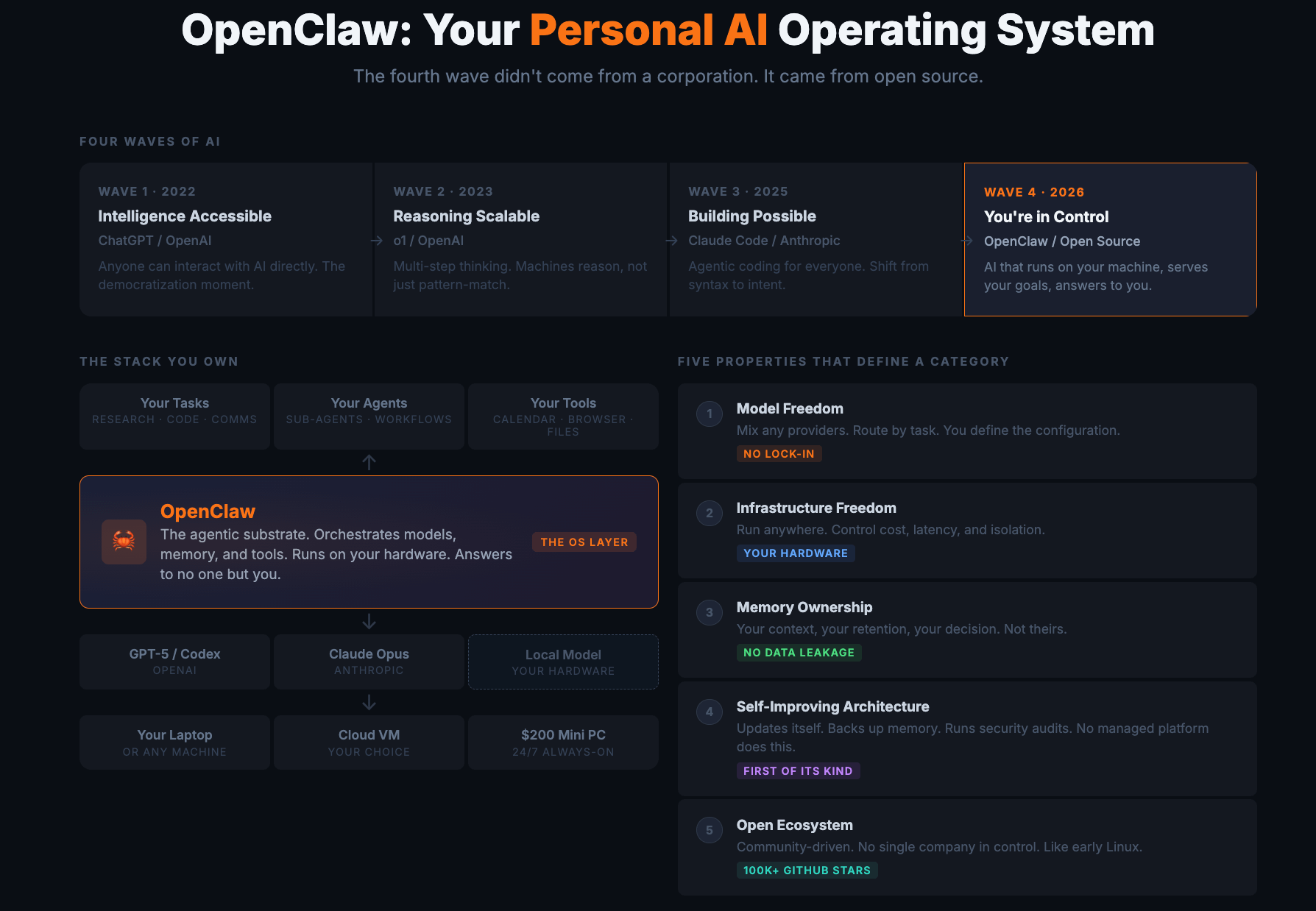
We’ve seen four major step changes in AI over the last four years.
The first made intelligence accessible. ChatGPT brought AI to everyone: ask questions, generate content, interact with intelligence directly. The democratization moment.
The second made reasoning scalable. The o1 model family unlocked structured, multi-step thinking. Machines started reasoning through problems, not just pattern-matching.
The third made building possible. Claude Code unlocked agentic coding for everybody. Coding shifted from syntax to intent. Anyone with an idea could build something real.
And now, a fourth. This one is different.
From Access to Agency
The first three waves came from AI labs like OpenAI and Anthropic. However, this fourth wave is coming from the open source community.
OpenClaw, created by Austrian developer Peter Steinberger, is the first complete expression of the idea: an AI that doesn’t just answer questions or write code. It acts on your behalf. Runs on your machine. Connects to your tools. Remembers your context. And does all of this without asking permission from a cloud provider.
Within weeks of launch, OpenClaw amassed over 100,000 GitHub stars. Jensen Huang called it “the operating system for personal AI” at GTC 2026. Steinberger has since joined OpenAI, and the project moved to an open-source foundation.
That trajectory tells a story. But the more interesting story is architectural, and why OpenClaw has defined a new category.
OpenClaw as an AI Operating System
OpenClaw is not an app. It’s a substrate.
Think of it like an OS for personal AI. Just as Windows or macOS gives you a computing foundation and you decide what runs on top, OpenClaw gives you an agentic foundation and you decide how to compose your AI.
In my own setup: my main agent runs on OpenAI’s Codex model. A research sub-agent runs on Anthropic models. A local model handles lightweight ops tasks. This is not a fixed configuration. It’s a recipe I control.
That’s the core difference. Most platforms give you access to intelligence. OpenClaw gives you control over how it’s composed, deployed, and orchestrated.
What Makes It Category-Defining
Five properties set OpenClaw apart.
1. Model Freedom
You’re not locked into one provider. Mix OpenAI, Anthropic, local models, future models. You’re the orchestrator.
Compare that to Claude Code (Anthropic models only), Manus under Meta (curated stack), or Perplexity Computer (19 models, but behind their managed layer). Powerful, but bounded. With OpenClaw, you pick the models. You define the configuration & routing.
2. Infrastructure Freedom
You choose where it runs: laptop, cloud VM, spare machine, Raspberry Pi, a $200 mini PC running 24/7. You control cost, latency, and isolation. No mandatory subscription. No enforced runtime.
3. Memory Ownership
With OpenClaw, you own your memory. Export it. Control retention. Your conversations, context, and interaction history live where you decide.
On most platforms, memory is stored and managed by the provider. Your context becomes part of their system, feeding their models, their analytics, their product decisions and creates the platform/product lock-in. OpenClaw is the first real alternative.
4. Self-Improving Architecture
This one surprised me most.
My OpenClaw instance backs up its own memory daily. It pulls updated releases every few days, installs them, and restarts the gateway. It runs security audits and applies improvements automatically.
This is the first sign of a genuinely self-maintaining system, not in the AGI-hype sense, but in the practical operational sense. An agent that updates itself and gets better over time without you managing every step. No managed platform offers anything close to this.
5. Open Ecosystem
OpenClaw is not controlled by a single company. It evolves through community contributions, diverse use cases, and rapid iteration.
The closest analogy that comes to mind is early Linux. Messy at first. Powerful over time. Eventually foundational most of the cloud computing today.
Tradeoffs
Power vs. Complexity
This level of control comes at a cost.
OpenClaw is not for everyone. Setup requires technical effort. The primary interface is CLI-driven, I know its not for everyone. Ongoing maintenance is real and time-consuming. Debugging is part of the workflow. You’re running a system, not using a product.
What you get in return is control. You make choices that suit your needs, your budget, your setup. That flexibility is earned through the investment of building it on your own terms.
Security and Trust
A lot of people sitting on the fence are worried about security. And they’re not wrong to be.
Curated platforms provide guardrails, abstract complexity, and offer structured security models. Cisco’s AI security team has already identified vulnerabilities in third-party OpenClaw skills, including data exfiltration risks. The Chinese government has restricted its use in state agencies. These are real concerns.
But there’s another lens.
With managed systems, your data lives with the provider. You’re trusting someone else’s security, and someone else’s incentives. With OpenClaw, you control where data resides and who has access.
NVIDIA’s NemoClaw, announced at GTC 2026, adds enterprise-grade security through policy-based privacy guardrails, sandboxing, and a privacy router that keeps sensitive data on local models. It’s early (still in alpha), but the trajectory is clear.
Open systems harden over time. Linux is the definitive example, now the most trusted computing foundation in the world. OpenClaw is early. But the pattern is familiar.
The Emerging Ecosystem
OpenClaw has defined a category. Now we’re seeing variants emerge, just like after Apple defined the tablet category with iPad or the wireless earbud category with AirPods.
Open Source Variants
ZeroClaw: a lightweight, MIT-licensed variant written in Rust. 3.4MB binaries, 22+ AI providers, runs on commodity hardware including Android. At the Boston OpenClaw meetup I organized, the ZeroClaw demo running on an Android phone was the show stealer.
NemoClaw from NVIDIA: the enterprise-ready variant, wrapping OpenClaw in security guardrails through OpenShell, a sandboxed open-source runtime. NVIDIA is integrating with Cisco, CrowdStrike, Google, and Microsoft Security stacks.
PicoClaw: ultra-small, built for wearables. The demos I’ve seen run on a custom chip roughly the size of an Apple Watch. Always available, always listening, always acting.
Each takes a slice of the larger idea: performance, security, portability.
Commercial Variants
Perplexity Computer (launched February 2026): orchestrates 19 AI models including Claude Opus, Gemini, Grok, and GPT-5.2. Powerful and polished, at $200/month. But it runs behind Perplexity’s managed layer.
Manus (acquired by Meta for $2 billion): originally from Chinese startup Butterfly Effect, now Meta’s consumer-facing agent. More accessible, but now embedded in Meta’s ecosystem with all the data implications that carries.
Anthropic’s expanding capabilities: Claude Cowork, scheduled tasks, remote execution, Telegram and Discord integrations. Anthropic is methodically building out the agentic experience, with their characteristic focus on safety and polish.
These are more polished and easier to use. They’re also more constrained and more tied to a provider. They’re not competing with OpenClaw directly. They’re productizing slices of the pie OpenClaw created.
Why This Moment Matters
Every previous wave in AI was driven by a corporation.
OpenClaw is the first time the state-of-the-art, category-defining system came from the open source community first. Corporations are now catching up. That inversion is significant.
Think about what’s at stake. In an AI-first future, everyone will have an agent that buys things on their behalf, communicates on their behalf, sets up meetings, manages schedules, handles administrative work that consumes hours of every day. These agents will know your preferences, your patterns, your priorities.
They will be the most intimate technology we’ve ever interacted with.
And the question is simple: who do these agents work for?
A corporation? Or you?
That is the meta point.
Corporations will come hard at this space: packaged, polished, one-click installs on every device. But those offerings always serve a master who is not you. Their KPIs, their data strategies, their business models. Even if you’re paying, your data flows through their infrastructure.
OpenClaw gives that control back.
Not Everyone Needs This
Not everyone wants to run their own AI system. Not everyone has the technical depth to manage setup, maintenance, and security. For that population, a well-packaged commercial offering is exactly the right path forward.
But for those who care about control, customization, and ownership, OpenClaw represents something new. A real axis of choice between convenience and control. Between managed and owned.
It doesn’t replace other tools. It expands what’s possible.
And for the first time, it puts the user back in control of their own AI.
Great framing of OpenClaw as a personal AI operating system.
One thing that helped our workflows become reliable was a tiny end-of-run receipt: goal → tools used → failure → recovery → next test. That single habit made debugging and iteration much faster.
If helpful, Giving Lab shares practical OpenClaw breakdowns with exactly this kind of real run evidence: https://substack.com/@givinglab