OpenClaw phenomena - the 4th Exponent

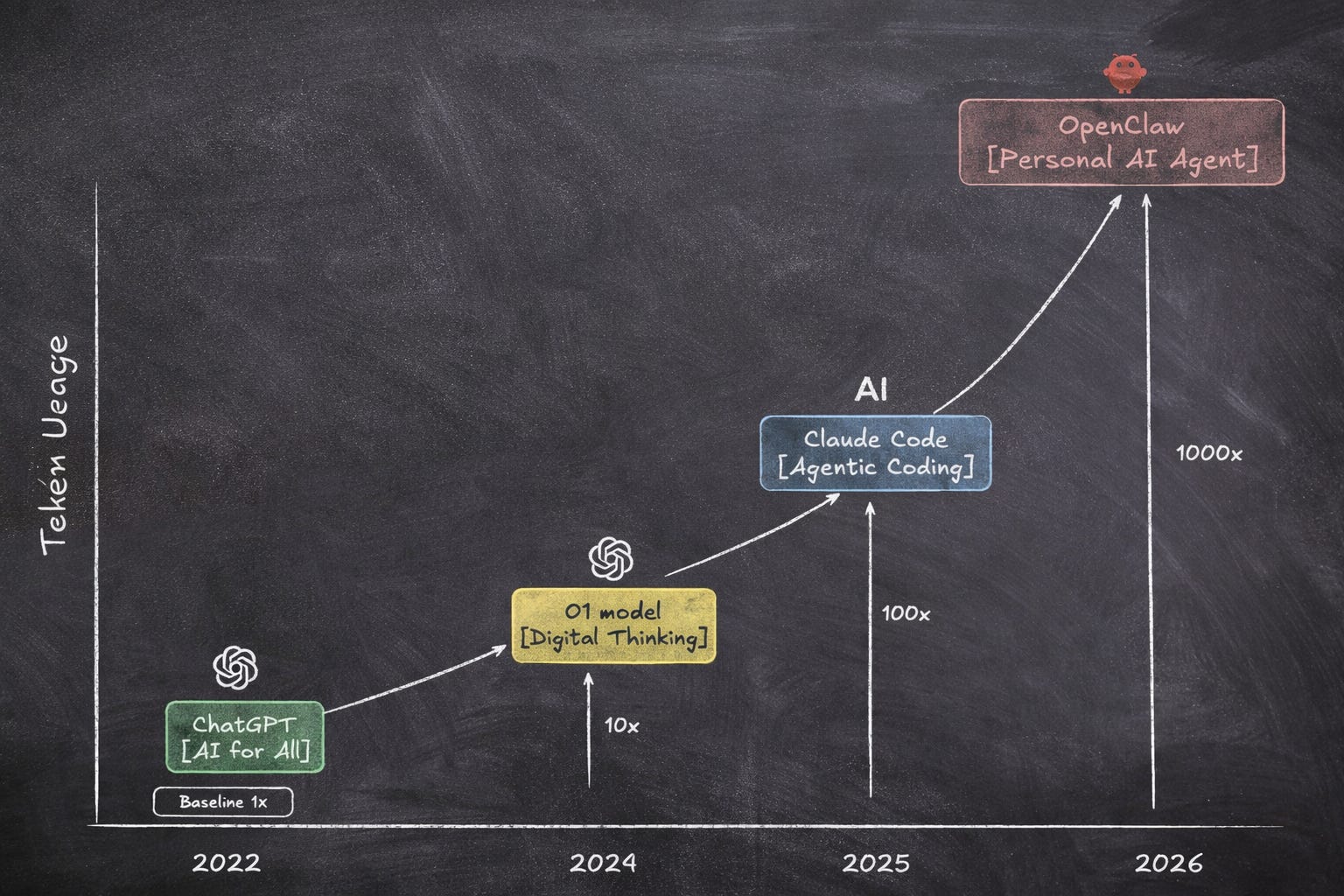
We’ve seen this happen three times. The fourth is unfolding right now. And every time the unit of work changes, the value AI creates doesn’t grow linearly. It grows in exponents.
Stage 1 — ChatGPT: The Knowledge Unlock (Nov 30, 2022)
ChatGPT reached 100 million users in 60 days. The fastest consumer app in history at the time. The state of the art AI was accessible to all. For the first time, anyone could sit down with a machine, ask it anything, and get a coherent, intelligent answer. No degree required. No search terms to craft. No expert to wait on. We entered what you might call the era of knowledge democratization, machines could answer questions, draft prose, explain complex ideas, and sound intelligent doing it.
However, the interaction was bounded to a human prompting and model responding. A typical exchange consumed 1,000 to 5,000 tokens. ChatGPT unlocked access to intelligence. It didn’t yet give us depth.
Stage 2 — o1: The Reasoning Unlock (2024)
On December 5, 2024, OpenAI released o1 fully. It was the real inflection point.
Before o1, every AI model operated the same way under the hood: take a prompt, run a forward pass, produce an answer. Fast. Automatic. System 1, in Kahneman’s terms. o1 changed the architecture of thinking itself. Instead of generating answers in one shot, the model could now engage in System 2 behavior, running internal deliberation loops, exploring alternative paths, catching its own mistakes, and only then producing a response.
Test-time compute enabled the models to generates reasoning tokens, a hidden chain of thought invisible to the user to produce a well formed reponse. Depending on how complex the problem is, those reasoning tokens can range from a few hundred to tens of thousands per request. The compute behind it is orders of magnitude larger. By late 2025, reasoning models represented over 50% of all token usage on OpenRouter.
Reasoning models changed the whole paradigm. We went from “let’s think step by step” as a clever prompt trick to taking deliberate, internal reasoning for granted in every AI interaction. Stage 2 gave us depth. It didn’t yet give us action.
Stage 3 — Claude Code: Coding is Solved (2025)
Claude Code, didn’t just generate code. It created a structural agent harness around the act of software creation, one that could read a codebase, propose a change, execute it, test it, observe the result, and try again. It turned a single prompt into a self-correcting software development loop.
Claude Code routinely consumed 100x the amount of tokens as compare to a Claude q&a query, not because the answers were longer, but because the loop itself was expensive. Reading code repos costs input tokens. Generating edits costs output tokens. Running bash commands and re-reading the modified file to verify? More tokens still. Multi-agent configurations — where teammate instances each maintain their own context window and run in parallel — pushed that multiplier to even higher limits. On OpenRouter’s top apps by token usage, Claude Code consumed roughly 97 billion tokens in a weekly window. Claude code was a category defining breakthrough, the nature of the task changed. The human’s role shifted from author to reviewer.
Claude Code changed coding permanently. We are not going back to hands-on-keyboard as the default.
Stage 4 — OpenClaw: The Personal AI Agent (2026)
OpenClaw, is not a coding assistant. It’s not a chatbot. It’s a personal AI gateway, self-hosted, multi-channel, and designed to act on your behalf across your digital life. Email. Calendar. Web browsing. Task management. Memory. All of it running through a continuous agent loop: intake context, assemble memory, call a tool, observe the output, loop again.
The adoption signal is impossible to ignore. In a single week in early 2026, OpenClaw received 2 million visitors. It crossed 100,000 GitHub stars. By late March 2026, it had crossed 332,000 GitHub stars and 64,000 forks.
The token data on OpenRouter tells the same story, but louder. Claude Code consumed ~97 billion tokens weekly on the platform. OpenClaw consumed ~743 billion. It’s the structural difference between a coding loop (bounded by a task, a repo, a session) and a personal agent loop (unbounded by design, running across memory, tools, and time) always running.
OpenClaw is where AI becomes personal. Your AI doesn’t wait for you to ask it something. It flags your important email before you open your inbox. It prepares your calendar context before your meeting. It acts. It persists. It remembers. The token count per workflow isn’t bounded by a session, it’s bounded only by what you need done.
Stage 4 gives us continuous assistance and actions.
Beyond Tokens: The Real Unit of Value
Tokens are a proxy. They measure compute consumed, not value created.
The better question is: what is the human now able to do that they couldn’t before?
At Stage 1, the unit was knowledge accessed — how many questions answered, how much research accelerated.
At Stage 2, it was output quality — problems solved that were previously too complex to attempt.
At Stage 3, it was tasks completed — how much code shipped, how many hours of engineering reclaimed.
At Stage 4, the unit changes again. It becomes human output amplified. Automation that eliminates human intervention, while multiplying outcome, decisions made on your behalf. Cognitive load that never lands on you because an agent absorbed it first.
A better way to think of it is as agent-hours worked on your behalf. An OpenClaw deployment doesn’t clock out. It monitors, triages, acts, and reports. The question stops being “how many tokens did it consume?” and starts being “how much of your cognitive surface did it absorb?”, “How many tasks were handled without your input?”, “How many decisions were pre-processed before they reached you?”, “How many workflows ran to completion without a human in the loop?”.
That’s the exponent Stage 4 introduces: the shift from AI that responds to AI that executes on your behalf. From on-demand to always-on. From assistant to agent.
This was always the destination. They lied when they said “there always will be human in the loop”. Every stage got us closer to machine autonomy. ChatGPT made intelligence accessible. o1 made it deliberate. Claude Code made it productive. OpenClaw makes it personal and autonomous, and we are not done yet.
The Exponent Doesn’t Stop Here
OpenClaw is the clearest instantiation of that fourth axis. We will not have passive AI anymore. The AI of 2026 and beyond will be proactive, autonomous, and acting on our behalf, maximizing human output beyond what we can currently imagine. The question is not whether this era has arrived and what it represents. It’s whether you’re building for it and are you ready for it.
Another forward looking questions comes to mind, what’s going to be the next unlock and when…
Ashish Bhatia is a Senior Product Manager at Audible, focused on GenAI-powered content discovery. He writes on AI strategy, product, and the agentic AI.