The Shifting Bottleneck: Human-in-the-Loop Was Always Temporary

When generative AI started making its way into enterprise workflows, the industry rallied around a reassuring narrative: humans must stay in the loop. It felt responsible. It felt safe. And for a while, it was useful.
But here’s what I’ve come to believe: human-in-the-loop was always a temporary narrative. A necessary one at the time to manage the transition, to calm the outcry, to buy time for adoption. The long-term arc was always toward human-optional or fully automated execution. Not because humans don’t matter. But because anytime you put a human in the middle of a process, you’ve created a bottleneck. And every system, eventually, wants to eliminate its bottlenecks.
The Bottleneck Always Shifts Upstream
Here’s what actually happens when organizations adopt AI at scale.
You automate the high-volume, repetitive work. Velocity spikes. You celebrate. Then you realize you’ve solved one problem and created another because the constraint didn’t disappear. It moved. It shifted to the next layer up, usually to your most expensive, most experienced people.
That pattern is playing out right now across industries. Here are three examples.
Example 1: Code Review is the New Bottleneck
When coding agents like Claude Code entered the picture, development teams saw immediate productivity gains. Developers could ship more code and at a faster clip. What could go wrong?
The PR queue starts to build up.
Cognition, the company behind Devin, said it plainly: “We’re hearing from our customers that code review — not code generation — is now the bottleneck to shipping great products.” (source) They even built a separate product, Devin Review specifically because of this problem.
The New Stack reported the same dynamic: “Using AI to increase velocity means that more code is being thrown over the wall, and someone has to review it. We’re actually starting to see that code review is becoming the new bottleneck.” (source)
Your principal engineers and senior developers — your most expensive, most strategic humans — are drowning in pull requests. They can’t keep up. So what do you do? You automate review too. But then who’s accountable when something slips?
The bottleneck shifted. And now it’s moving again.
Example 2: Radiology — Faster Scans, Harder Decisions
Radiology is one of the most advanced examples of AI entering a high-skill profession. AI can now flag anomalies in imaging studies before a radiologist even opens the file. It automates quality assurance, eliminates routine screening work, and dramatically increases throughput.
And yet, demand for radiologists is actually growing, up 9% even as AI adoption accelerates. (source)
Why? Because AI handled the volume. What’s left are the hard cases. The anomalies that don’t fit standard patterns. The clinical context that requires judgment. The communication of nuanced findings to a patient’s care team.
Nature published research on this directly, AI tools reduce routine workload, but radiologists get increasingly concentrated on edge cases and high-stakes interpretation. (source)
The bottleneck didn’t disappear. It moved upstream to the most complex, highest-consequence decisions in the workflow. And the human sitting at that chokepoint is now under more pressure than ever.
Example 3: Recruiting — The Screener Isn’t the Problem Anymore
Hiring at scale used to break down at the top of the funnel. Thousands of resumes, limited recruiter time, qualified candidates slipping through. AI fixed that.
Unilever used AI to filter out 80% of applicants, cutting time-to-hire by 90% and saving over 50,000 hours of recruiter time. (source)
But here’s what happens next. The hiring manager’s calendar fills up. The candidates AI passed still need to be interviewed. Culture fit, leadership potential, team dynamics, those aren’t things you automate away. A survey by Insight Global found 93% of hiring managers believe human involvement remains essential even with AI screening in place. (source)
The bottleneck didn’t go away. It moved from resume screening to final-stage evaluation, which by the way, is exactly where your senior leadership spends time.
The Pattern is the Point
Code review. Radiology. Recruiting. Three different industries, same story.
You automate the volume layer. Throughput increases. Then the constraint migrates to wherever human judgment is hardest to replace. And the people sitting at that new chokepoint are your most valuable, most expensive resources; principal engineers, senior radiologists, hiring executives.
This is the trap that most organizations are walking into right now. They measure AI adoption by deployment. “We gave everyone a coding agent”. “We launched an AI screener”. They celebrate the initial productivity gains and stop there. They don’t realize they’ve shifted the problem, not solved it.
Where Humans Actually Belong
Here’s the framework I keep coming back to.
There are two ends of any workflow that should always be in human hands:
Specification — What needs to be done? What problem are we solving? What does success look like? This is intent-setting. It’s strategic. It cannot and should not be delegated.
Validation — Did it work? Were the objectives actually met? Did the outcome match the intent? This is verification. It requires judgment. It also cannot and should not be delegated just yet.
Everything in between is implementation detail. Writing the code. Screening the applicant. Flagging the scan. That is where machines should operate. That is where you keep pushing automation.
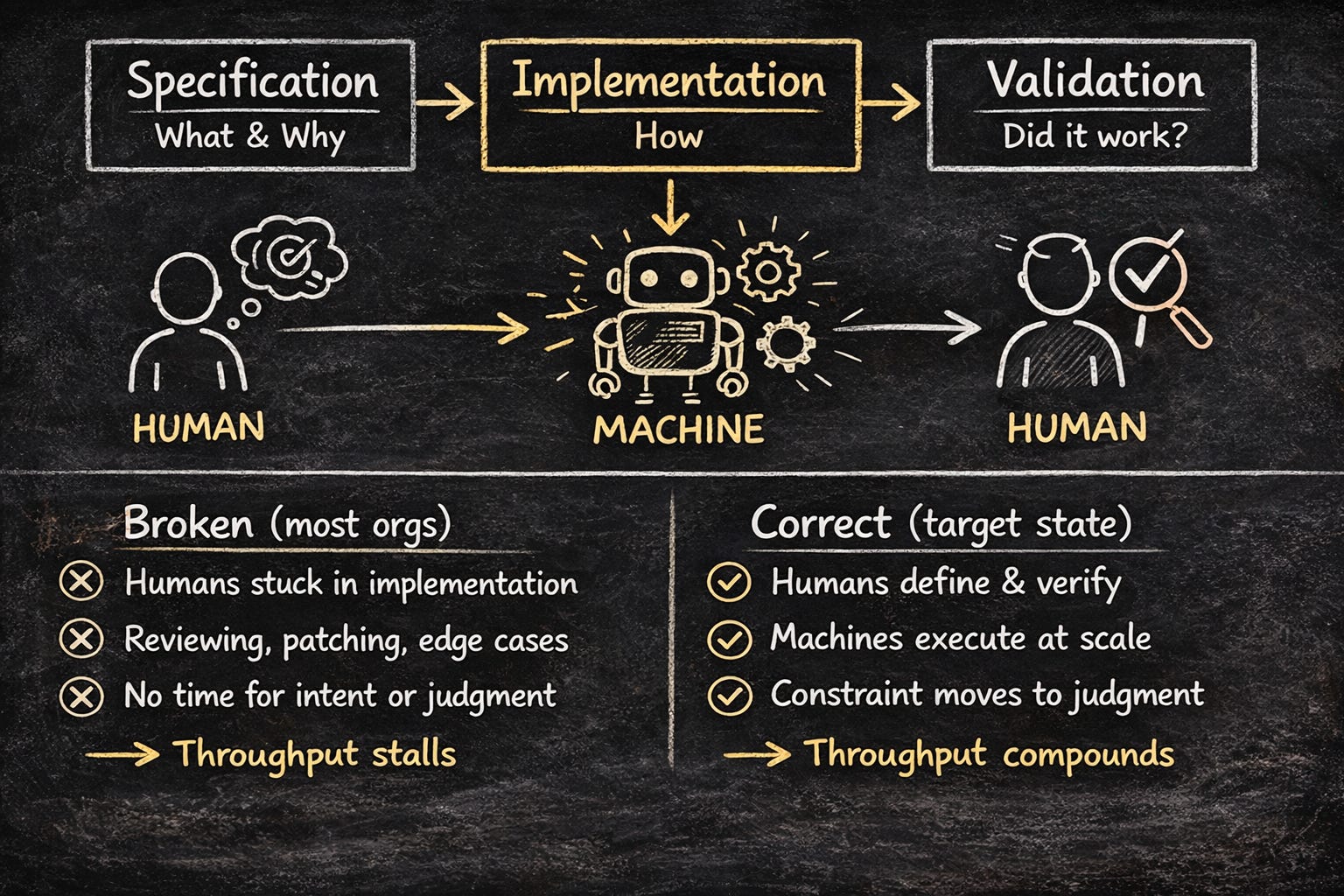
But here’s the critical point: you can only hold those two ends of the thread if the middle is clear. If humans are stuck somewhere in the implementation layer; reviewing code, screening edge cases, manually processing what automation missed, then they can’t focus on specification and validation. The whole system degrades.
The Job of Organizational Leaders
If you’re a VP, a product leader, or a decision-maker in an AI-forward organization, this is what I want you to take away:
AI adoption is not a finish line, that was last year’s goal. Identify the human bottlenecks.
Every time you automate a layer, the constraint moves upstream. Your job is to see it coming, name it, and eliminate it, before it becomes the new chokepoint that slows everything down.
The cycle looks like this:
Automate the current bottleneck
Watch where the constraint migrates
Identify the new chokepoint
Plan to eliminate it
Repeat
Humans are not going away. But they will keep moving to higher and higher layers of judgment, until either those layers get automated too, or we reach a decision of such consequence that we decide the liability simply must sit with a person.
Until that moment, the job is to keep clearing the path. Eliminate the bottleneck. Hold the two ends of the thread. Let machines handle everything in between.
That’s how you lead in an AI-first world.
Sources
Cognition (Devin) — Code Review as the New Bottleneck
Source: Cognition Blog — “Devin Review: AI to Stop Slop”
Cognition Blog — Devin Annual Performance Review
Devin Docs — Devin Review
The New Stack — Is AI Creating a New Code Review Bottleneck for Senior Engineers?
UDS Health — AI in Radiology: Why Demand for Humans is Growing 9%
Nature — AI Solutions to the Radiology Workforce Shortage
Oxford Academic — BJR Artificial Intelligence: Radiology Report Generation
HeroHunt.ai — AI-Driven Candidate Screening: The 2025 In-Depth Guide
x0pa.com — AI Resume Screening